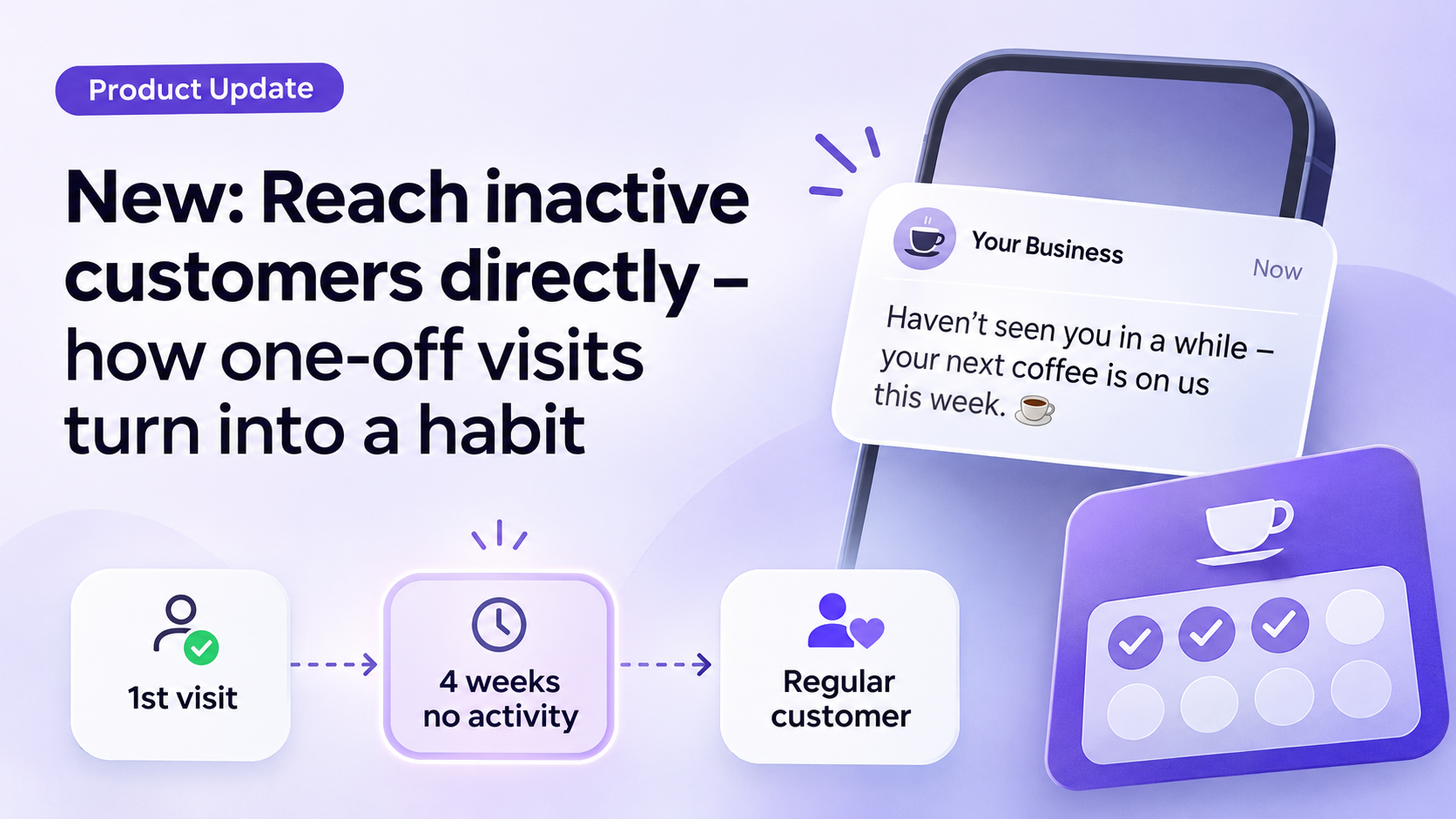
New: Reach inactive customers directly – how one-off visits turn into a habit
November 14, 2026 · 5 min read
Key takeaways
Until now, PlaceAlive Cards let you message every holder of a PlaceAlive Card for your business. From now on, you can also target the specific group whose card has shown no activity in the past four weeks. That's exactly the group where it's decided whether a single visit becomes a habit - or whether the customer quietly disappears without anyone noticing.
A base of regulars isn't built on the first visit, but on the third, fifth and tenth. The critical phase lies right in between: the guest came in, they liked it, and then – nothing happens. No argument, no complaint, no opt-out. They simply don't come back, because something else got in the way and the visit never became a routine. The new feature makes it possible to address exactly this moment for the first time.The “paper or digital?” debate is often too black and white. Some businesses assume paper is simple and digital is complicated, while others believe digital is automatically better. Neither tells the full story.
Why building regulars is a question of habit
Building a base of regulars is, at its core, a habit-forming process - and habits need repetition over a longer period than most people assume. A widely cited study from University College London found a median of 66 days before a new behavior became automatic, with considerable variation between 18 and 254 days depending on the person and the behavior. A 2024 meta-review confirms this order of magnitude with a median between 59 and 66 days.At first glance, a paper stamp card costs next to nothing – a few cents for printing, plus a stamp, and you’re done. Look more closely, however, and hidden costs begin to appear that rarely make it into the calculation.
For a business, that means something very concrete: between the first visit and the point where “that's where I always go” is genuinely a habit, there are typically several months and several visits. That's a long window in which a customer can drop out at many points - and there's a notable finding from the same research: one or two missed opportunities don't meaningfully impair habit formation. Those who stay highly irregular, on the other hand, don't develop a habit at all.
Translated into day-to-day operations: a single missed visit isn't a problem. Several weeks of silence is one, because that's when the regularity breaks down that carries habit formation in the first place. This is precisely why the four-week mark is a sensible point to act: early enough that habit formation hasn't fully stalled, late enough that it doesn't come across as pushy.
The real problem: churn happens silently
Most businesses never find out that they've lost a customer. There's no signal, no cancellation, no occasion. The guest is simply absent - and because new guests come in every day, it simply doesn't register in daily operations.
With a paper punch card, this gap can't be closed at all technically: the business doesn't know who was last there and when, and therefore can't target anyone specifically. Digital systems only solve half of it as long as they can only send messages to everyone at once. Because messaging everyone mainly reaches the people who were coming back anyway. That's the group where a reminder changes the least.
What the new feature does
From now on, you can select the group of cardholders on the Business Platform whose PlaceAlive Card has recorded no activity in the past four weeks. You can then send this group its own messages and offers, separate from your communication to everyone else.
This means you can now respond in a targeted way instead of casting a wide net. An offer goes to the customers where it can actually change something – not to those who are going to show up next week regardless.
If you send an offer to all cardholders, you grant the discount to everyone who would have come without it. For regulars who visit twice a week anyway, that isn't an incentive - it's a margin loss on revenue that was already coming.
Targeted outreach to inactive customers reverses this ratio:
The discount only goes to customers whose next visit is genuinely uncertain.
The message is more relevant to its recipients, because it fits their situation instead of going out generically to everyone.
Regulars aren't bothered with offers they don't need – which preserves their attention for messages that really matter.
On top of that, there's a point that follows from the economics of existing customers: a customer who has already been in once has cleared the biggest hurdle – the initial decision to choose your business. Getting them to come back again starts from a considerably lower hurdle than winning an entirely new guest.
What outreach can look like
The right message differs significantly by industry and price level. A few examples of how this can look:
Café or bakery: “Haven't seen you in a while - your next coffee is on us this week.”
Bar or restaurant: “We've reworked the menu. Drop by before Sunday and get an aperitif on the house.”
Beauty or nail salon: “It's been a while since your last appointment – this month there's 20% off your next treatment.”
Tattoo studio: “Our autumn calendars are open. Get in touch by the end of the month to secure your slot.”
Yoga or Pilates studio: “You've taken a break. Here's your way back in: one class of your choice, free.”
Two principles apply regardless of industry: the message should contain a concrete occasion and a clear timeframe, and it shouldn't sound reproachful. “We miss you” lands differently than “You haven't been in for a long time.”
What to keep in mind
A targeted reactivation offer is effective, but it isn't a tool for permanent use. Two notes from practice:
Don't send too often. Messaging inactive customers every week doesn't create an incentive, it creates numbness. A clearly defined occasion works better than a standing offer.
Limit the discount. A time-limited offer creates an occasion; an open-ended permanent discount just shifts your margin for good.
Conclusion
A base of regulars isn't built on a good first impression, but on repetition over weeks and months. This phase is exactly where the biggest gap used to be: businesses couldn't tell who was in the process of falling out of the routine, and so couldn't respond either. With targeted outreach to inactive cardholders, this moment can be made visible and addressed for the first time – before a pause turns into a final goodbye.
Frequently Asked Questions
When does a customer count as inactive?
Why not simply message all customers at once?
How often should you reach out to inactive customers?